Design for your business
Logo or visual identity: what are you paying for, and what do you need?
You are starting a business, launching a product or finally ready to present your work more professionally. You need a name, a website, perhaps Instagram and, of course, a logo.
You ask a few designers for quotes and receive very different proposals. One offers logo design, another a basic visual identity, and a third describes the service as branding.
The prices vary, and you still need an answer to one simple question: “What am I actually getting for my money?”
If you do not work in design, it is completely understandable that the difference is unclear. Especially when everything is presented through a few attractive images, technical terms and lists of files that mean little to you.
A logo is the mark people use to recognise your business. Your visual identity includes that mark and defines how everything around it looks, from menus and packaging to your website and social media.
IN THIS ARTICLE
What is a logo, and what is a visual identity?
A logo can be a specially designed business name, a symbol or a combination of both. It appears on your materials and helps people identify whose products, services or content they are looking at.
A visual identity includes your logo and the other elements that create a recognisable look for your business:
- Colours used across your materials.
- Typography, meaning the fonts used for headings, body text and other information.
- Graphic elements, such as patterns, lines, shapes or illustrations.
- Photography direction, meaning the kinds of photographs you choose and how you use them.
- Layout guidelines, which define how these elements work together.
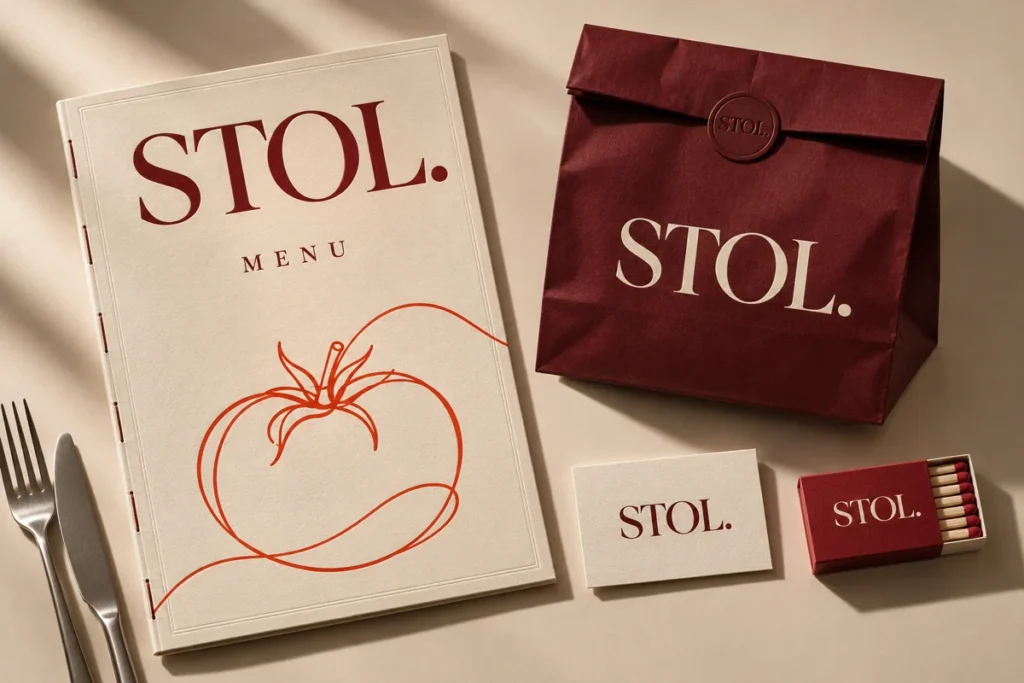
One restaurant. A connected look.
Identity exampleSTOL.
The logo is the starting point.These elements shape the look of everything around it.
What does this mean
in practice?
The same colours, different applications.
The chosen colours appear across the menu, packaging and posts. Each new piece has a clear starting point and looks connected to the restaurant.
A visual identity brings individual elements together into a recognisable whole.
Click or tap an element ↑Depending on the project, the service may also include ready-to-use templates or the design of specific materials. The difference becomes clearer when you need to create something new after receiving your logo. You have the logo, but the rest of the material still needs to be designed.
You are opening a restaurant. What do you actually need?
Imagine you are opening a restaurant. You have chosen a name and now need a menu, an entrance sign, an Instagram profile and takeaway packaging.
Explore the difference
STOL.
The restaurant’s core mark
One direction across your materials. Colours, typography and graphic motifs connect the menu, packaging and other restaurant materials.
These five questions explain what logo design gives you and what a developed visual identity adds. Open the question you want to explore.
01What do I receive, and where can I use it?
You receive a design for the restaurant’s name, a symbol or a combination of both. Depending on the agreement, you also receive versions for different backgrounds and sizes. You can place the logo on a menu, entrance sign or takeaway box, but those materials still need to be designed.
You receive a logo and a developed visual style around it: colours, fonts, graphic elements and guidelines for combining them. This gives the restaurant a shared foundation across its different materials.
02What will my menu look like?
You have a logo for the cover. You still need to choose fonts for dish names, how prices appear, colours, category layouts and the other details that make a menu easy to read.
You have defined fonts, colours and layout guidelines to design the menu around. For example, it is clear how to distinguish a dish name from its description and price. A completed menu design is included only if it is listed in the proposal.
03How do I connect Instagram, signage and takeaway boxes?
The same logo can appear on all of them. However, if different fonts, colours and styles are chosen for each item, the rest of the design may feel disconnected.
Selected colours, fonts and recognisable details repeat across different materials. Posts and packaging do not need to look identical, but they follow the restaurant’s shared visual style.
04What happens when I need a new offer or seasonal menu?
You have a logo, but the person creating the next piece may need to make all the other decisions again or try to recreate the style from previous examples.
There are guidelines that you, an employee or another designer can follow. If templates are included, you can update some content within an existing design.
05Do I receive all the finished materials?
Only if those tasks are specifically listed in the proposal. Logo design does not automatically include designing and producing everything the logo will appear on.
Again, only if they are listed in the proposal. A visual identity defines the shared look, while designing individual materials, printing, sign production or website development may be separate services.
When you need your next piece of design, how many decisions are already made?
With a logo, you have your recognisable mark. With a developed visual identity, you also have guidelines for designing everything around that mark.
Packages vary between designers, so always check the specific list of deliverables.
Why do quotes vary so much, and what am I paying for?
If one proposal includes logo design and another also includes typography, a colour palette, templates, packaging and usage guidelines, they cover different amounts of work.
The designer’s experience, project complexity, deadlines and the amount of research and development can also influence the price.
A clearly defined project may involve:
- discussing your business, customers and goals;
- reviewing competitors and how they present themselves;
- developing and explaining a design direction;
- creating and refining the design;
- checking readability, contrast and different applications;
- preparing the agreed files, templates and guidelines.
When you look at the finished logo, you see the outcome of that process. Some of the work behind it is not visible in the image itself.
“But my logo is just a few letters. Why does it cost so much?”
A simple solution can take considerable development.
A restaurant logo needs to be readable on the entrance, clear in a small profile picture and suitable for the agreed printing or production methods. How it works in one colour and how it differs from other restaurant logos also matter.
The complexity of the drawing and the amount of work involved are different things.
You can assess the value more usefully by asking: does it suit my business, does it work where I need it, and will I receive the files and guidance to use it?
A higher price alone is not proof of a better solution. A good proposal should explain what will be done, why it matters and what you will be able to use afterwards.
Do customers actually notice these details?
A guest probably will not comment on your font choices or menu layout guidelines. But they may notice that the text is hard to read, that prices are difficult to find or that the restaurant feels completely different on Instagram and its website.
Research helps us understand several parts of this process.
Recognition needs to be built
In an international study by Ipsos and agency JKR involving more than 26,000 respondents, only 15% of the tested assets reached their highest standard of distinctiveness and clear association with a particular brand.
What was tested, and where is the source?
The study tested assets such as logos, slogans, mascots, colours and products. The result describes the tested assets, not the proportion of successful businesses. Ipsos: Be Distinctive. Everywhere. ↗
Logos matter, and colour alone is not enough
An analysis of 1,281 identity elements across 13 consumer packaged goods categories in 19 countries found strong potential for characters, logos and logotypes to become uniquely associated with a brand. Colour was more difficult to establish as a unique identifier because competitors often share it.
Read the original research
Ward and colleagues: Building a unique brand identity, Journal of Brand Management ↗
The overall design shapes the first visual impression
Research presented by Google Research found that visual complexity and similarity to an expected website structure influence aesthetic judgements even after very brief exposure. Simpler websites with more familiar structures generally received better ratings.
What does this result tell us, and what does it not?
Effects were observed at exposure times of 17 to 50 milliseconds. This concerns aesthetic impressions of websites, not purchasing decisions. Google Research: a summary of the study by Tuch and colleagues ↗
For your business, this means that choosing a colour or symbol is just the beginning of building recognition. People need to encounter those elements and learn which business they belong to.
Professor Jenni Romaniuk of the Ehrenberg-Bass Institute highlights the importance of using assets consistently alongside the brand name to develop that association. Read: Brands of Distinction ↗
A visual identity should support a good logo with carefully selected elements. More colours, patterns or decoration do not automatically make a better design.
Will a visual identity increase my sales?
A visual identity can support recognition and help you present your business more clearly. Sales also depend on your offering, quality, price, availability, promotion and customer experience.
The studies cited here do not provide a universal comparison between businesses that purchased only a logo and those that commissioned a full identity. They do not justify promising a particular increase in revenue.
In the restaurant example, even the best-designed menu cannot replace good food and service. It can, however, help guests read the offer more easily, while a consistent visual style can support recognition of the restaurant.
I want my materials to look connected, my information to be clear, and to avoid inventing a new look every time I need to publish something.
You can use these needs to assess what a design project offers you.
What does my business need?
I am just starting my business
It makes sense to define what you will actually use during the first few months.
For a small restaurant, this could include a logo with the necessary variations, colours, typography, concise guidelines, a menu and a few post templates. If you offer delivery from the start, packaging may be important too.
A different business will need different materials. A consultant might prioritise a presentation, proposal and website, while a manufacturer may need packaging design.
The scope should reflect your actual needs. A clearly defined foundation can be developed further later.
My materials already have a consistent style, but I need a logo
A focused logo design project may make sense. The new logo should fit the existing visual style, and you should receive the variations needed for its intended applications.
Logo design can also be an agreed first phase of a larger project. In that case, clarify which decisions will be left for later.
I have a logo, but everything else feels disconnected
You may not need a new logo at all. If the existing mark works well, the project can focus on colours, typography, photography, content layouts and templates.
Before a redesign, identify exactly what is not working. Changing the mark alone will not fix a hard-to-read menu or disconnected social posts.
Do all my materials have to look the same?
A consistent identity leaves room for different content.
A seasonal menu, a post about a special event and a recruitment ad can have different layouts, photographs and amounts of text. Shared colours, fonts, heading styles and other recognisable details can connect them.
A good system provides enough guidance for materials to belong to the same business and enough flexibility for each piece to do its job well.
What should I ask before accepting a proposal?
Clarify the following before you agree:
- What exactly is included?Ask for a list of the designs, materials, templates and guidelines you will receive. Check whether the applications shown are visual demonstrations or actual production-ready deliverables.
- How will we work together?What are the stages, deadlines, number of included revisions and process for giving feedback?
- Which files will I receive, and how will I use them?Will you have suitable versions for web, print and other agreed applications? Can you edit the agreed templates yourself?
- What additional costs might arise?For example, fonts, photographs, printing, sign production, website development or additional materials.
- How does the proposed design suit my business?The designer should be able to explain their decisions and connect them to your audience and needs.
The answers will help you compare proposals based on what you actually receive.
How do I get started?
Write down where people will encounter your business over the next six months. Will it be Instagram, a website, packaging, a shopfront, proposals, presentations or workwear?
Then consider what you already have, what is missing and what you will use most often. That list is a useful starting point for talking to a designer and defining a scope that suits your budget.
A logo gives you a recognisable mark. A visual identity gives you a way to present that mark and the rest of your business consistently in practice.
Not sure where to start?
Tell us what you do, what you already have and which materials you plan to use. We will help you define what you need now and build a foundation you can develop later.
Explore our visual identity projects